Compare lactate curves between athletes: 4 key parameters explained
Learn how to compare lactate curves between athletes by analyzing LT1, LT2, VLamax, and curve shape. A practical guide to interpreting aerobic fitness differences.
Updated: May 27, 2026
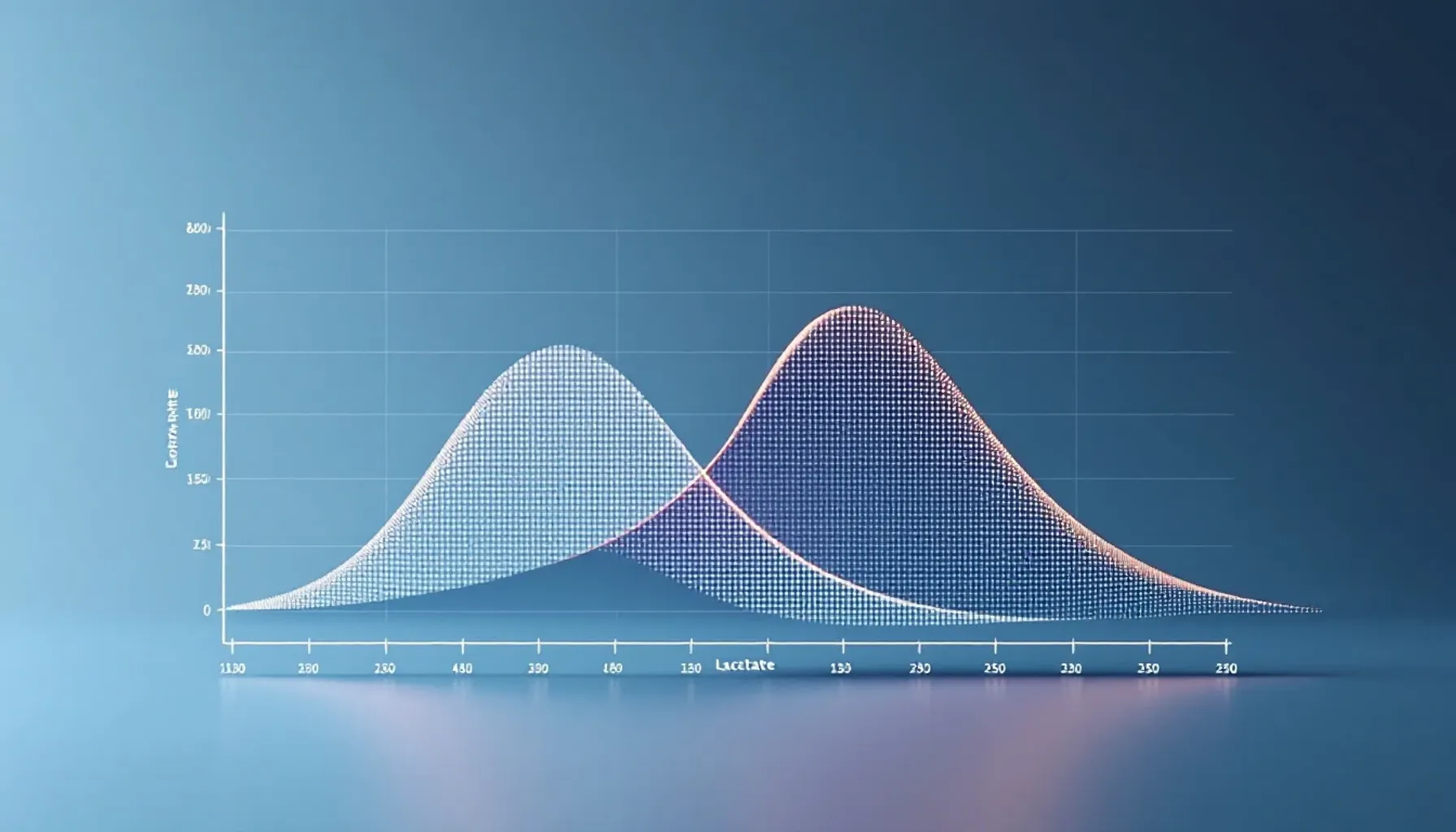
How to Compare Lactate Curves Between Athletes: A Practical Interpretation Guide
Comparing lactate curves between athletes reveals differences in aerobic base, anaerobic capacity, and training state. A curve shifted right means lower blood lactate at the same intensity—a hallmark of better aerobic fitness. The most diagnostic comparison points are the position of LT1 (aerobic threshold), LT2 (anaerobic threshold / MLSS), the slope between them, and the plateau lactate at maximal effort. Two athletes can share the same LT2 wattage yet have completely different curve shapes, and that difference determines how they should train.
Key entities in lactate curve comparison:
The Four Parameters That Define a Curve's Character
LT1: where aerobic metabolism starts to be supplemented
LT1 marks the first inflection point—the intensity at which blood lactate rises detectably above baseline. Below LT1, fat oxidation dominates and the athlete can sustain effort for hours. Above it, carbohydrate contribution increases progressively. In well-trained endurance athletes, LT1 typically sits at a higher absolute wattage or pace than in untrained individuals, where it appears at lower absolute intensities. LT1 is the primary target for base-building training because raising it expands the range of intensities that feel aerobically comfortable.
LT2 / MLSS: the ceiling of sustainable intensity
LT2—often equated with the maximal lactate steady state (MLSS)—is the intensity above which lactate accumulates continuously and performance becomes time-limited. Stanula et al. (2013) describe several calculation methods for identifying this threshold from step-test data, each with slightly different numeric outputs but the same physiological meaning. For practical training zone design, LT2 defines the boundary between Zone 3 and Zone 4 in most polarized or threshold-based models.
Slope between LT1 and LT2: the metabolic buffer zone
The slope of the curve between LT1 and LT2 is one of the most underused diagnostic parameters in practice. A gentle slope suggests the athlete can sustain a wide range of intensities with only moderate lactate accumulation—a large metabolic buffer. A steep slope suggests small increases in pace or power push lactate sharply upward, leaving less room for error in pacing. Coaches comparing two athletes with similar LT2 values should check this slope before prescribing identical training zones, though individual responses to training may still vary.
Peak lactate and VLamax: what the top of the curve reveals
The lactate value at maximal effort—and the rate at which it was reached—reflects VLamax, the maximal rate of anaerobic glycolysis. Sprinters may reach peak values in the range of 18–22 mmol/L; pure endurance athletes often peak lower, sometimes in the 8–12 mmol/L range, though individual variation is substantial. High peak lactate signals high anaerobic glycolytic capacity. Messonnier et al. (2013) showed that trained and untrained men differ not just in threshold position but in lactate kinetics—trained athletes clear lactate more efficiently at the same relative intensity, which tends to flatten the upper portion of their curve.
---
Reading the Differences: A Side-by-Side Curve Comparison
!Lactate curve comparison chart showing three athlete profiles: well-trained endurance, untrained recreational, and overtrained/fatigued—clean minimal illustration with three distinct curve shapes on a single axis
Well-trained endurance athlete: the rightward, flat-slope curve
A well-trained endurance athlete's curve typically starts near 1 mmol/L, stays relatively flat through moderate intensities, and only bends upward at high wattage or pace. LT1 sits at a high absolute intensity, the slope between LT1 and LT2 is gradual, and peak lactate at maximal effort is often moderate. This shape reflects high mitochondrial density, efficient lactate clearance, and a low-to-moderate VLamax.
Untrained or recreational athlete: steep slope, early LT2
An untrained athlete's curve tends to rise early and steeply. LT1 appears at low absolute intensities, the slope between LT1 and LT2 is sharp, and LT2 is reached at a relatively low wattage or pace. Peak lactate may be high because the glycolytic system is active but clearance is inefficient. This profile means any intensity above a brisk walk or easy jog quickly becomes metabolically stressful.
Overtrained or fatigued athlete: suppressed lactate, misleading flatness
This is the most dangerous archetype to misread. An overtrained or acutely fatigued athlete may show a flat, low-lactate curve that superficially resembles a well-trained profile. The difference: their power output or pace at each step is also suppressed. The curve looks "good" only because the athlete cannot push hard enough to generate lactate. Coaches who rely on lactate values alone without recording the corresponding intensity at each step will miss this pattern entirely.
Lactate Curve Comparison Table: Trained vs. Untrained vs. Overtrained Athletes
| Athlete Profile | LT1 Position | LT2 Position | Curve Slope (LT1→LT2) | Peak Lactate | VLamax Indicator | Practical Implication |
|---|---|---|---|---|---|---|
| Well-trained endurance athlete | High absolute intensity (e.g., ~200–230 W cycling*) | High absolute intensity (e.g., ~280–320 W cycling*) | Gentle / gradual | Moderate (often 10–14 mmol/L) | Low-to-moderate | Wide aerobic base; large buffer zone; can sustain high tempo efforts |
| Untrained / recreational athlete | Low absolute intensity (e.g., ~80–120 W cycling*) | Low absolute intensity (e.g., ~140–180 W cycling*) | Steep | High relative to output (often 12–18 mmol/L) | Moderate-to-high | Narrow buffer zone; intensities above easy pace quickly become unsustainable |
| Overtrained / acutely fatigued athlete | Appears high but at reduced power output | Appears adequate but at reduced power output | Deceptively flat | Suppressed (often 6–10 mmol/L) | Appears low | Misleading profile; low lactate reflects impaired glycolytic drive, not fitness |
Example values for illustration only; actual thresholds vary widely by individual, body mass, sport, and training history.
How to identify your profile: Record both the lactate value and the corresponding wattage or pace at every step. If your lactate values are low but your power or pace at each step is also lower than your previous test, you are likely looking at a fatigue profile, not a fitness gain. A genuine rightward shift means lower lactate at the same or higher intensity.
---
What Curve Shifts Mean Over Time for the Same Athlete
Understanding how to interpret a shift in lactate curves is the most practically valuable skill in repeated testing. The key rule: the entire curve must shift, not just one threshold point.
Rightward shift: lower lactate at the same wattage or pace
A rightward shift means the athlete produces less lactate at every intensity tested. For example, at 200 W, lactate was 3.2 mmol/L in January; in April it is 2.1 mmol/L. That drop reflects increased mitochondrial capacity, better fat oxidation, and more efficient lactate clearance—all genuine aerobic adaptations. Both LT1 and LT2 move to higher absolute intensities. This is the clearest signal that base training is working.
Leftward shift: overtraining, illness, or detraining signals
A leftward shift—higher lactate at the same intensity—indicates reduced aerobic capacity. This can follow several weeks of detraining, a viral illness, or accumulated fatigue from excessive training load. The curve steepens and both thresholds appear at lower absolute intensities. Identifying a leftward shift early allows a coach to reduce load before performance collapses.
Why shifting LT2 alone without shifting LT1 is a warning sign
If LT2 moves right but LT1 stays fixed or moves left, the aerobic base has not improved—only the anaerobic ceiling has shifted, possibly due to high-intensity training that raised glycolytic capacity without building mitochondrial density. This pattern produces athletes who can suffer through hard intervals but fatigue quickly in long races. The fix is more volume at intensities below LT1, not more threshold work.
---
How VLamax Changes the Curve Shape Across Athlete Types
High VLamax: steep curves and strong sprint capacity
A high VLamax means the glycolytic system fires rapidly, flooding the bloodstream with lactate even at moderate intensities. The curve rises steeply from early on. Sprinters, team-sport athletes, and track cyclists typically show this profile—peak lactate values can reach 16–22 mmol/L or higher in some individuals. The trade-off: high VLamax tends to suppress fat oxidation and push LT2 to a lower percentage of VO₂max, which limits endurance performance.
Low VLamax: flat curves and superior fat oxidation
A low VLamax means anaerobic glycolysis contributes minimally until very high intensities. The curve stays flat and low across a wide intensity range. Pure endurance athletes—marathon runners, Ironman triathletes, road cyclists specializing in long climbs—often cluster here. Low VLamax enables high fat oxidation rates, preserves glycogen, and keeps LT2 at a high percentage of VO₂max.
Matching VLamax to sport demands when comparing athletes
When comparing curves across athlete types, VLamax is the single parameter that most clearly separates sport-specific metabolic profiles. A sprinter with a low VLamax may be undertrained for their event; an Ironman athlete with a high VLamax risks bonking mid-race. Curve comparison only makes sense when you account for what each athlete's sport actually demands.
---
How to Compare Your Own Curve Using an Online Step-Test Analysis
What data you need from a step test to generate a comparable curve
To produce a lactate curve that can be compared across tests or athletes, you need: (1) a consistent step protocol—fixed step duration (typically 3–5 minutes), fixed increment size (e.g., 25 W per step in cycling), and a warm-up at the same wattage each time; (2) a blood lactate value at the end of every step; (3) the exact intensity (watts, pace, or speed) at each step. Missing any of these makes cross-test comparison unreliable.
Interpreting the output: LT1, LT2, and curve overlay across tests
LactateThreshold.online takes your step-test data and calculates LT1, LT2, VLamax, and the full curve in around 60 seconds. The most useful comparison feature is overlaying curves from two different test dates. Look for: (a) whether the curve body has shifted right at the same intensity levels, (b) whether LT1 and LT2 have both moved, and (c) whether the slope between them has flattened. If only one threshold moved, investigate why before adjusting training zones.
Common mistakes that make two curves incomparable
- Different step durations between tests: Step duration affects lactate accumulation. A shorter step (e.g., 3 minutes) tends to produce lower lactate values than a longer step (e.g., 5 minutes) at the same wattage because lactate has less time to accumulate—though the magnitude of this effect varies by individual and protocol. Always use the same protocol for valid comparisons.
- Different warm-up intensities: Starting hotter in one test elevates baseline lactate and compresses the early part of the curve.
- Inconsistent sampling timing: Taking blood at minute 2:45 instead of minute 3:00 systematically underestimates lactate at each step.
- Comparing cycling and running curves directly: Different muscle mass recruitment means lactate values are not interchangeable between modalities—always compare within the same sport.
---
FAQ
Why do two athletes with the same LT2 wattage have different-shaped lactate curves?
LT2 wattage reflects only the ceiling of sustainable intensity. The curve shape between rest and LT2 depends on LT1 position, VLamax, and mitochondrial density. One athlete may reach LT2 via a gentle slope with a wide aerobic buffer; another may have a steep slope with almost no buffer zone. Same ceiling, completely different metabolic architecture—and different optimal training prescriptions.
What does a flat lactate curve at low values mean?
A flat, low-lactate curve often indicates good aerobic fitness—but only when the corresponding power outputs or paces are also high. If lactate is flat at low values because the athlete is testing at reduced intensity—due to fatigue, illness, or overtraining—the flatness is misleading. Always record intensity at every step, not just lactate values, to distinguish genuine fitness from suppressed output. Context matters: a flat curve at 300 W signals something very different than a flat curve at 150 W.
How many step-test data points do I need to draw a reliable lactate curve?
A minimum of 5–6 data points across a meaningful intensity range is generally required for a reliable curve fit. Fewer points produce a curve that is too sensitive to individual measurement noise. Most protocols use 6–8 steps, starting below LT1 and ending above LT2, which gives enough resolution to identify both thresholds and characterize the slope between them.
Can I compare lactate curves from different sports—for example, cycling vs. running?
Not directly. Lactate values at the same relative intensity differ between sports because of differences in active muscle mass and movement economy. A cyclist's 3 mmol/L at 250 W is not equivalent to a runner's 3 mmol/L at 4:30/km pace. You can compare the shape and threshold positions within each sport modality, but cross-sport lactate comparisons require normalization to relative intensity (% VO₂max) rather than absolute units.
How often should an athlete repeat a lactate step test to track curve changes?
Every 8–12 weeks is a practical frequency for most endurance athletes in structured training. Testing more often than every 6 weeks rarely captures enough adaptation to produce a meaningful curve shift. Testing less often than every 16 weeks risks missing a leftward shift—detraining or overtraining—before it affects race performance. Key moments to test: end of base phase, end of build phase, and after any extended illness or training disruption.
Frequently asked questions
Why do two athletes with the same LT2 wattage have different-shaped lactate curves?
LT2 (the anaerobic threshold) represents a single intensity point, but the curve's shape between LT1 and LT2 depends on VLamax, muscle fiber composition, and aerobic enzyme activity. One athlete may reach LT2 with a gradual lactate rise (low VLamax, high aerobic capacity), while another hits the same wattage with a steep, abrupt rise (high VLamax). The shape reveals the metabolic pathway mix — not just the threshold intensity.
What does a flat lactate curve at low values mean — is it always a sign of good fitness?
Not necessarily. A flat, low-lactate curve can indicate excellent aerobic conditioning, but it can also signal overtraining or acute fatigue, where the body's ability to produce lactate is temporarily suppressed. Context matters: if the flat curve appears after a heavy training block and performance has dropped, suspect fatigue rather than fitness gain. Compare with previous tests and subjective performance data before drawing conclusions.
How many step-test data points do I need to draw a reliable lactate curve?
A minimum of 5–6 intensity steps is generally recommended to produce a curve with enough resolution to identify both LT1 and LT2 accurately. Fewer points make it difficult to distinguish the inflection zones. Each step should be 3–5 minutes long to allow blood lactate to stabilize, and the starting intensity should be low enough that the first 1–2 values fall below 1.5 mmol/L.
Can I compare lactate curves from different sports — for example, cycling vs. running?
Direct comparison of absolute values is not valid across sports because lactate production depends on the muscle mass engaged and the movement economy of each discipline. A trained cyclist may show LT2 at 280 W on the bike but a very different lactate response on a treadmill. Meaningful cross-sport comparison requires sport-specific step tests and should focus on relative metrics like LT1 as a percentage of VO2max rather than absolute wattage or pace.
How often should an athlete repeat a lactate step test to track curve changes?
Most coaches recommend testing every 8–12 weeks during a structured training cycle — often at the end of a base phase and again after a build phase. Testing more frequently than every 6 weeks rarely shows meaningful curve shifts and adds unnecessary fatigue. Consistency in protocol (same time of day, same pre-test nutrition, same equipment) is more important than testing frequency for valid curve comparisons.